Home Gadgets
Choosing Better Lighting for Different Rooms
Rooms feel wrong either because the light is in the wrong place or because it is the wrong colour. This room-by-room guide covers lumens, colour temperature, layers and dimmers.

A solar garden light is a small panel, a small battery and an LED. Most disappointments come from how those three suit the season and the spot, not from any one part.
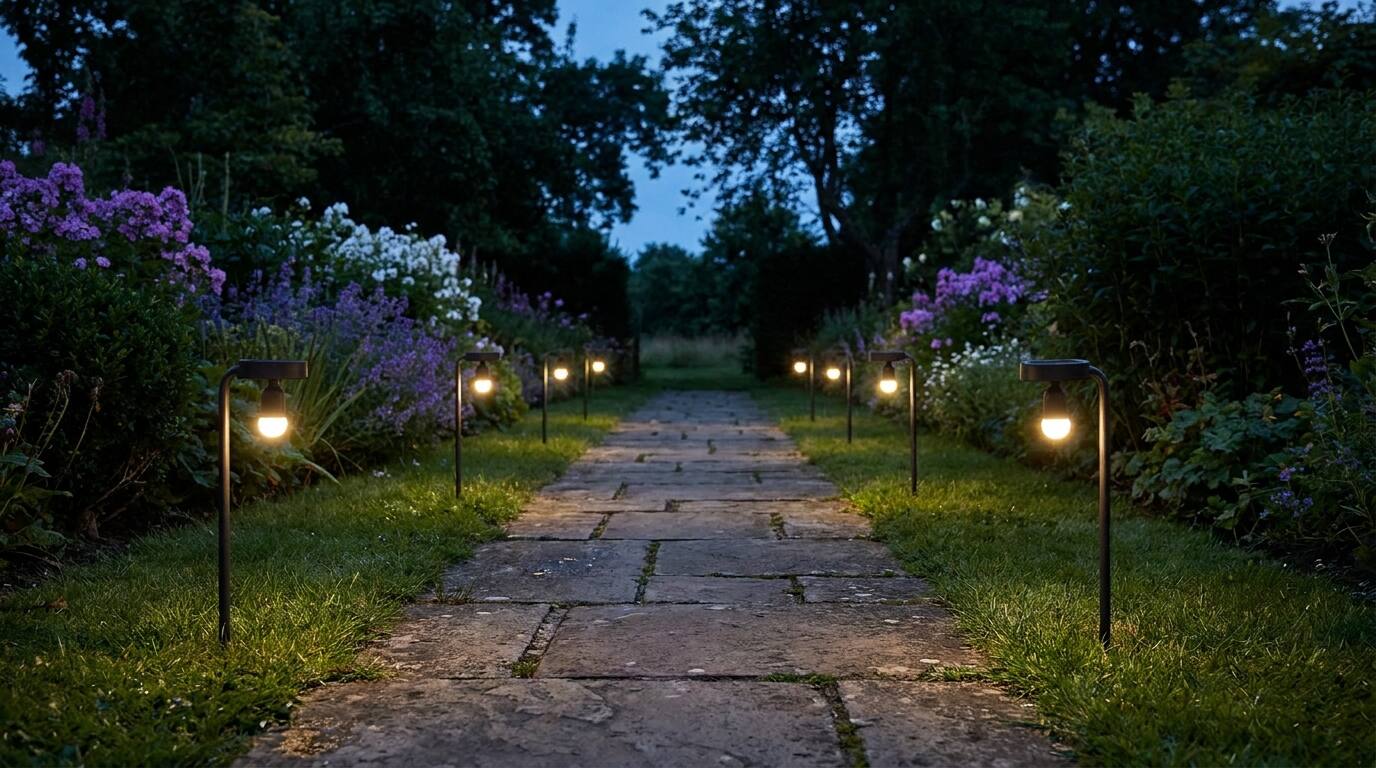
A solar garden light is a tiny energy system in one housing: a panel that gathers light by day, a battery that holds it, and an LED that spends it after dark. When these lights disappoint, the cause is usually a mismatch between those three parts, or between the light and the spot it was pushed into, rather than a single faulty component. This guide takes the parts in the order that tends to matter, beginning with the thing most buyers check last: the calendar.
Sunshine is not spread evenly through the year, and the gap grows with distance from the equator. The Met Office's UK averages for 1991 to 2020 record 171.49 hours of sunshine in June and 42.68 hours in December. Divided by the days in each month, that is about 5.7 hours a day in midsummer and 1.4 in midwinter (illustrative arithmetic from the monthly totals). Sunshine hours count bright sun rather than every scrap of usable daylight, so a panel still collects something on a grey day, but the direction is clear. A light that lasts the night comfortably in June is working from a far smaller supply in December, just when the nights are longest.
Canada adds snow and frost to the picture. Natural Resources Canada publishes monthly photovoltaic estimates for any location, and says plainly that the monthly values are indicative and do not account for temperature or snowfall. A panel under snow produces nothing until it is cleared, and a small panel set flat at ground level will be buried sooner than one tilted on a stake. Australia needs the same thinking with the calendar flipped, so the low-light months fall roughly from June to August. Location matters as much as month: Geoscience Australia describes the continent as having the highest solar radiation per square metre of any continent, and says the regions with the highest solar radiation are the desert regions in the northwest and centre. A light on the Australian coast should not be assumed to enjoy desert-interior conditions.
A larger panel collects more light only if it is lit. Many inexpensive lights put a small panel on top of the lamp head, which ties the panel to wherever you want the light. If that spot is under a hedge or a deck rail, the panel starves regardless of its size. Models with a separate panel on a lead let you put the lamp in the shade and the panel in the sun, at the price of a cable that needs routing and protecting.
In the northern hemisphere, including Canada and the UK, a fixed panel generally does best facing south; Natural Resources Canada's maps are built around south-facing fixed arrays for the same reason. In Australia the equivalent is north. Watch for winter shade too: a spot that is open in June can sit behind a bare tree's branches or a low sun's long shadows in December.
The cell is the part that wears out first. Chemistry matters: Battery University lists lithium iron phosphate (LFP) at a nominal 3.2 to 3.3 V per cell with a cycle life of 2,000 and higher, against nickel manganese cobalt (NMC) at 3.6 to 3.7 V and 1,000 to 2,000 cycles. A solar light cycles roughly once a day, so 2,000 cycles is a little over five years (2,000 ÷ 365, illustrative arithmetic). Those figures are laboratory-style estimates, and the same source cautions that real-world life is often shorter.
Cold is the second battery question. Battery University gives 0 °C to 45 °C as the charging range for lithium-ion cells and warns that charging below freezing can plate metallic lithium on the anode, causing permanent loss of performance and safety margin, even though charging appears normal. Discharging is more forgiving, with a stated range of -20 °C to 60 °C. A well-designed light may stop charging in a hard frost to protect its cell; a poorly designed one may not. Product pages rarely say, so a stated operating-temperature range is a point in a product's favour, and silence means unknown.
The most practical feature is a replaceable cell. A light whose battery is soldered in is finished when the battery fades; one with a standard, accessible cell can be revived for the cost of the cell. Use the cell type the manual specifies.
IP codes come from the international standard IEC 60529, which the IEC describes as covering the classification of degrees of protection provided by enclosures for electrical equipment. A code has two digits: the first rates protection against solid objects, including dust, on a scale from 0 to 6; the second rates protection against water, on a scale from 0 to 9. Where a digit is replaced by X, that aspect was not rated, so IPX4 says nothing about dust. The rating describes a specific test, so for salt air, chemicals or other conditions, follow the maker's guidance.
| Code | Dust | Water | Where it fits |
|---|---|---|---|
| IPX4 | Not rated | Protected against splashed water | Sheltered beds and porches |
| IP54 | Dust protected | Protected against splashed water | General garden use |
| IP65 | Dust tight | Protected against water jets | Exposed paths, hose-down areas |
| IP67 | Dust tight | Protected against the effects of temporary immersion | Spots that can flood or pool |
Higher is not automatically better value. Most garden positions are well served by the middle of the table, and the more useful question is whether a seal will survive years of frost expanding and contracting plastic. A rating describes a new unit on a test bench.
| Spec | Good sign | Be wary of |
|---|---|---|
| Panel | Stated size, angle that can be adjusted, or a separate panel on a lead | Tiny panel fixed to a lamp head in a shaded spot |
| Battery | Chemistry named, replaceable, operating range given | Only a 'mAh' figure with no chemistry or temperature range |
| IP rating | Full code such as IP65, matched to the position | Marketing words like 'weatherproof' with no code |
| Modes | Dim, motion-sensing or steady options | A single always-bright mode that drains the cell by midnight |
| Mounting | Stake plus wall bracket, sturdy joint | Thin stakes for lawns that freeze or frost-heave |
If you also want lighting for a patio or kitchen door that must work every evening regardless of weather, consider a mains-powered fitting there, and keep solar for decoration and low-demand path marking. The principles of layering light in Choosing Better Lighting for Different Rooms translate outdoors too. For gear that needs real capacity, such as camping lanterns, Portable Power Stations Explained for Beginners explains the wider battery picture. More in the Outdoor & Travel section.
They can, with limits. Daylight is short, snow can cover small panels, and lithium cells have charging limits near and below 0 °C. Expect shorter run-times and clear snow off panels when you can.
Direct sun charges them best. Diffuse light on an overcast day still contributes, but the supply falls, so treat a shaded position as a compromise.
For sheltered or occasionally splashed positions, often. The X means dust was not rated, and the 4 covers splashing only. For fully exposed spots, a dust-tight code that also covers water jets, such as IP65 gives more margin.
How we research. Based on manufacturer documentation and the sources listed below. Know Your Gadget did not test products for this article. See our editorial policy.
Home Gadgets
Rooms feel wrong either because the light is in the wrong place or because it is the wrong colour. This room-by-room guide covers lumens, colour temperature, layers and dimmers.
Everyday Tech
The biggest number on a power bank, its mAh rating, is the hardest to compare. Watt-hours, conversion losses and USB power negotiation explain what you really get, and what airlines look at.
Outdoor & Travel
Watt-hours, watts, battery chemistry and what a campsite load really needs, worked through with simple arithmetic you can repeat for your own gear.