Outdoor & Travel
Portable Power Stations Explained for Beginners
Watt-hours, watts, battery chemistry and what a campsite load really needs, worked through with simple arithmetic you can repeat for your own gear.

The biggest number on a power bank, its mAh rating, is the hardest to compare. Watt-hours, conversion losses and USB power negotiation explain what you really get, and what airlines look at.
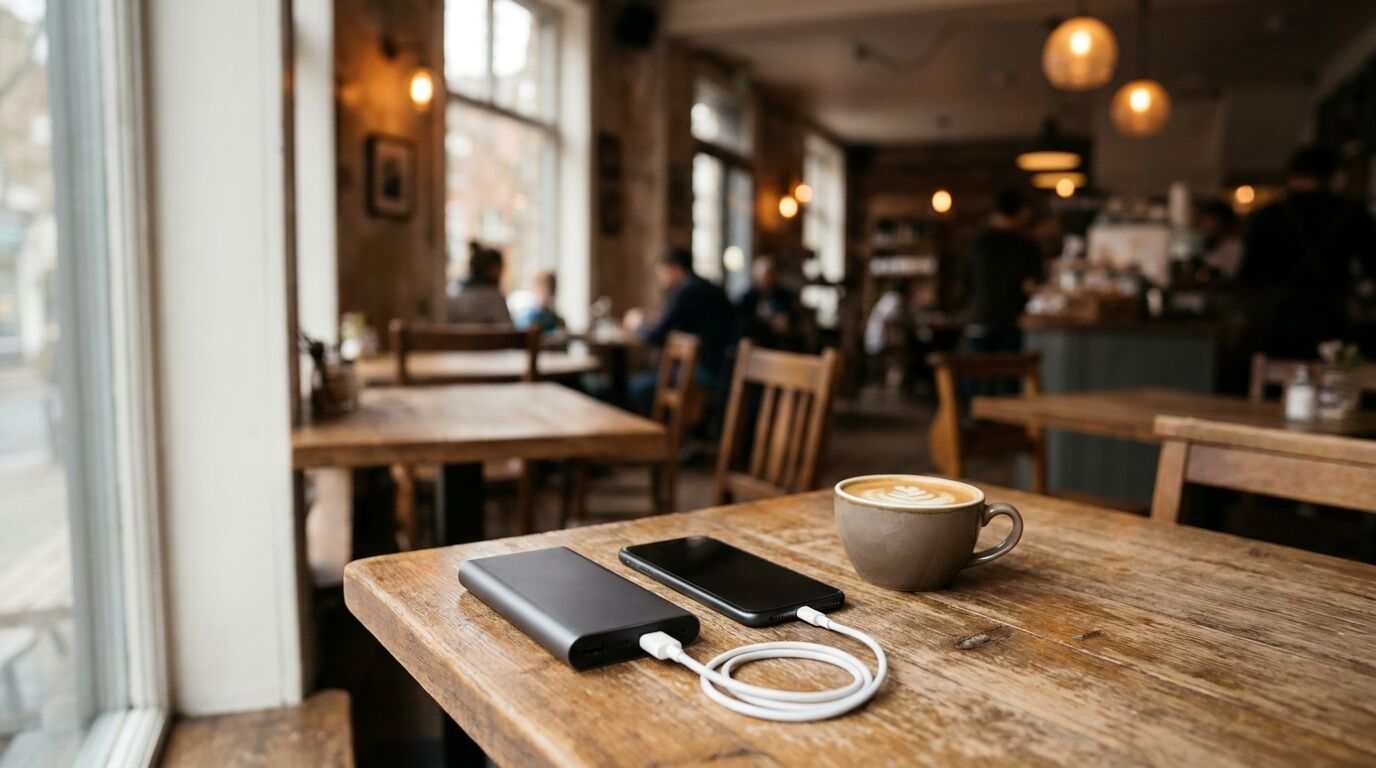
Two power banks can both say 10,000 mAh on the front and still hold different amounts of energy. The number most prominently printed on the box is a count of electric charge, and charge alone does not tell you how many times a phone will refill. Energy does, and getting from one to the other takes one multiplication.
Energy in watt-hours (Wh) is voltage multiplied by amp-hours. Canada’s airport security agency gives the same method for finding a battery’s rating when only mAh is printed: divide by 1,000 to get amp-hours, then multiply by the voltage. The catch is which voltage. Lithium-ion cells have a nominal voltage that depends on their chemistry. Battery University lists 3.6 V for several common types, 3.7 V for others, and 3.2 to 3.3 V for lithium iron phosphate. A power bank’s mAh figure is often quoted at the cell voltage, not at the 5 V or higher that comes out of the USB port, so check how the maker states it.
Take a pack marked 10,000 mAh. Dividing by 1,000 gives 10 Ah.
Assume 3.7 V cells: 10 Ah × 3.7 V = 37 Wh. With 3.6 V cells the same label would mean 36 Wh.
Stepping the cell voltage up to the voltage a phone requests wastes some energy as heat, and the phone’s own charging circuit loses a little more. Assume 75 per cent survives: 37 Wh × 0.75 = 27.75 Wh.
Assume a 15 Wh phone battery: 27.75 ÷ 15 = 1.85 full charges, not the two a naive reading of the label might suggest.
| Assumed efficiency | Energy delivered | Charges of a 15 Wh phone battery |
|---|---|---|
| 65 per cent | 24.05 Wh | 1.60 |
| 75 per cent | 27.75 Wh | 1.85 |
| 85 per cent | 31.45 Wh | 2.10 |
The lesson is about direction rather than precision. A manufacturer’s efficiency figure is often not stated, so allowing for losses means expecting somewhat fewer charges than the label suggests. When comparing two packs, favour the one that prints a watt-hour rating, since it removes the voltage guesswork.
Power in watts is volts multiplied by amps. A port delivering 5 V at 3 A is 15 W; 20 V at 3 A is 60 W; 20 V at 5 A is 100 W. USB Power Delivery is the standard that lets a charger and a device agree on a combination. The USB Implementers Forum says the original limit was 100 W using 20 V and 5 A over a suitably rated USB-C cable, and that Revision 3.1 adds fixed voltages of 28 V, 36 V and 48 V for up to 240 W. It also says devices negotiate for the power they need, so a low-power product takes only what it requires. A powerful pack will not force 100 W into a phone that asks for far less.
In practice three links must all be fast enough:
Do not forget the pack’s own recharge. Again as illustrative arithmetic, a 37 Wh pack fed at a constant 18 W needs at least 37 ÷ 18, a little over two hours, before any losses; charging commonly eases off as a battery fills, so real times will be longer. Check the stated input power, because some packs charge slowly even when their output is fast.
Regulators treat a power bank as a spare lithium battery. Transport Canada’s safety alert says spare lithium batteries, including power banks, must be in carry-on baggage only. If a carry-on is checked at the gate or planeside, they must be taken out and kept with you in the cabin, with the terminals protected against short circuit. The UK Civil Aviation Authority sets out thresholds in watt-hours: up to 100 Wh needs no airline approval, 100 to 160 Wh needs the airline’s approval, and a maximum of two per person applies. It also says power banks must not be recharged on the aircraft and should not be used to charge other devices there.
That is where the arithmetic matters. At 3.7 V, a 100 Wh limit corresponds to roughly 27,000 mAh (100 ÷ 3.7 × 1,000, about 27,027), so a pack in that range deserves a look at the printed watt-hour figure before you pack. CATSA’s guidance adds that many airlines prohibit charging on board, and that spares should be kept away from coins or keys, in original packaging, taped over at the terminals or in their own pouch.
Before the airport
For something larger than a pocket pack, see portable power stations for beginners, which uses the same watt-hour thinking. Packing a whole bag of chargers and cables is covered in compact travel gadgets, and more guides sit under Everyday Tech.
How we research. Based on manufacturer documentation and the sources listed below. Know Your Gadget did not test products for this article. See our editorial policy.
Outdoor & Travel
Watt-hours, watts, battery chemistry and what a campsite load really needs, worked through with simple arithmetic you can repeat for your own gear.
Outdoor & Travel
A short list of gadgets that earn their space in a carry-on, a second list of ones that often do not, and five questions for deciding about anything else.

Everyday Tech
A Bluetooth tracker has no GPS and no mobile connection of its own. Here is how finding networks locate a lost item, where they fall short, and how unknown-tracker alerts work.