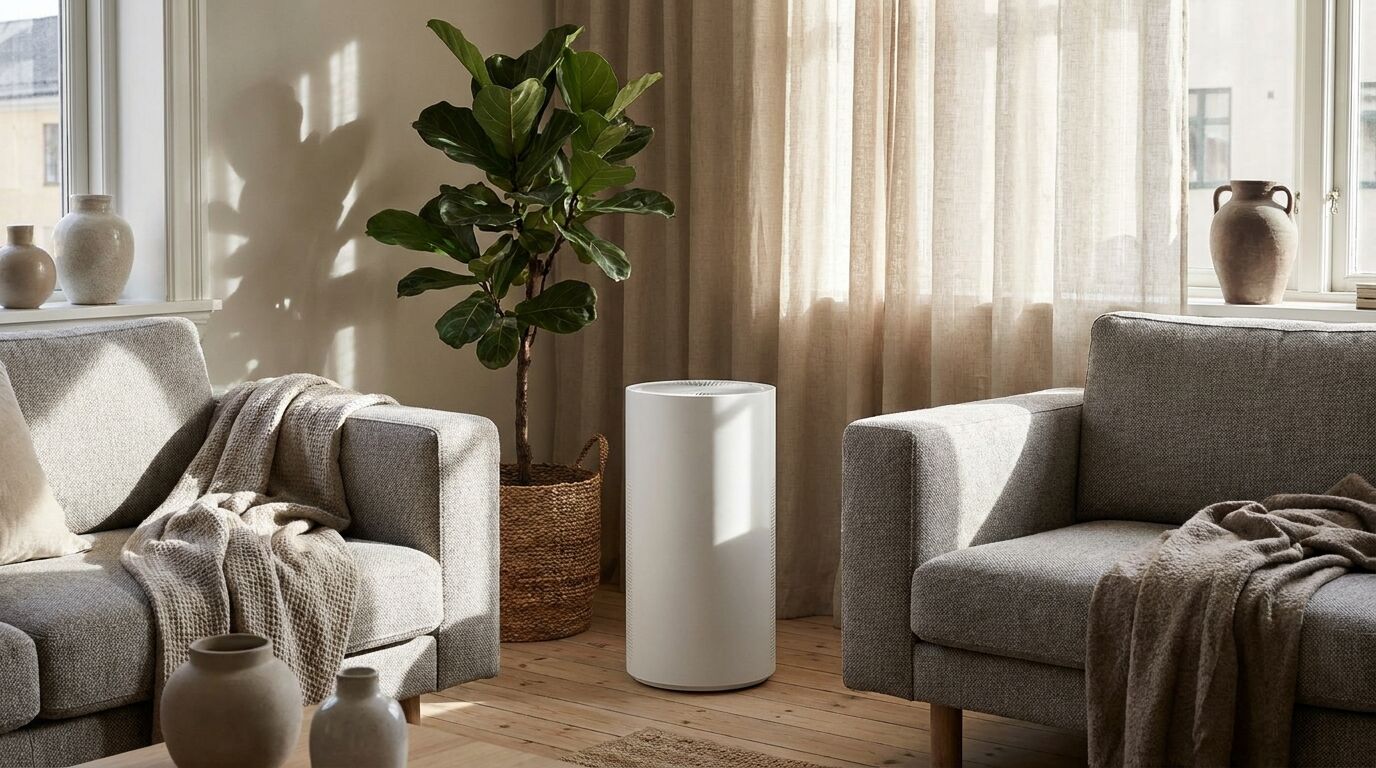
A portable air purifier is a filter with a fan. Matching its airflow to your room, avoiding ozone and knowing what filters cannot do matter far more than the extra features.
By Know Your Gadget6 min read
At a glance
Match the smoke CADR on an independent label to your room area; a common rule is at least two-thirds of the floor area in square feet.
HEPA filters handle particles; activated carbon may help with some gases, but there is no widely used rating for it.
Avoid any device that deliberately produces ozone, and check ozone certification for ionisers and electrostatic models.
A purifier supplements ventilation and source control; it does not replace them.
Turn an air purifier’s box around and the figures worth finding are small and unglamorous: three CADR numbers, one each for tobacco smoke, dust and pollen, printed on an independent certification label. Filter-stage counts, app dashboards and “air changes per hour” claims are easier to market than to compare. This guide works through the decisions in the order that affects results most.
Start with the room, not the product
CADR, the clean air delivery rate, describes how much particle-free air a unit delivers; a higher figure means more particles removed and a larger area served. It is a particle rating only, and it is usually measured at the highest fan speed. Health Canada’s guidance points buyers to units certified by the Association of Home Appliance Manufacturers (AHAM), whose label lists separate CADR values for tobacco smoke, dust and pollen because each uses a different particle size.
For fine particles, including wildfire smoke, Health Canada says to look at the tobacco smoke figure. Its rule of thumb is that the smoke CADR should be at least two-thirds of the room’s area in square feet. A 20 m² living room is roughly 215 sq ft, which points to a smoke CADR of about 145 or more. The US EPA gives a similar estimate of roughly 65 CADR per 100 sq ft, assuming ceilings of about 2.4 m (8 ft).
One caveat for readers outside North America: the AHAM label is the scheme cited by Canadian and US agencies. We did not verify an equivalent label in the UK or Australia for this article, so where it is missing, look for a manufacturer’s stated airflow for particles and the test method behind it, and treat a bare “covers 60 m²” claim with caution.
What each technology actually does
Common purifier technologies and their main limits, based on Health Canada, EPA and CARB guidance
Technology
What it targets
Main caveat
HEPA filter
Fine particles such as smoke, dust and pollen
Most units with one do not remove gases; filters need replacing
Activated carbon (or similar absorbent)
Some gases, including volatile organic compounds (VOCs)
No widely used performance rating; thicker carbon beds work better, per the EPA
Electrostatic precipitator or ioniser
Particles
Can produce ozone; look for ozone certification
UV, photocatalytic or plasma units
Often marketed for gases and germs
The EPA says these have not been shown to remove gases effectively in residential units
Ozone generator
Sold as a freshener or sanitiser
Deliberately produces ozone, a lung irritant; avoid in occupied homes
Health Canada notes that HEPA filters are commonly used to reach a high CADR, and that both airflow and filter efficiency determine performance. A purifier with a good filter and a weak fan will clean a room slowly; a strong fan behind a poor filter will not capture much. This is why a single CADR figure is more informative than a list of filter layers.
Ozone is the feature to rule out
The harder cases are ionisers and electrostatic precipitators, which are sold as ordinary air cleaners but can emit ozone as a by-product. Health Canada recommends models certified by the California Air Resources Board (CARB) or meeting the CSA 22.2 187-15 ozone standard. CARB’s limit for electronic air cleaners is 0.050 ppm, and certified products carry the wording “Meets California ozone emissions limit: CARB certified” and appear on its public list. Be wary of terms such as “activated oxygen” or “super-oxygenated air”, which CARB flags as warning signs.
Running it: noise, filters and habits
Noise. Higher fan speeds filter more air, but they are louder. Health Canada suggests considering a unit with a lower noise rating, especially for a bedroom, where you may be tempted to run it on low and lose most of the benefit.
Filter replacement. The EPA says manufacturer guidance typically means every 60 to 90 days, sooner if a filter looks heavily soiled. A dirty filter performs poorly. Check the replacement filter’s cost and availability before buying the unit, not after.
Placement. Keep walls, furniture and curtains from blocking airflow, and do not aim the outlet directly at people. Run it in the room where you spend most time, with doors and windows closed.
Run time. Longer run times and higher speeds filter more air, so a unit sized generously can work on a lower, quieter setting.
What a purifier cannot do
Health Canada and the EPA agree on the main limit: removing the source and ventilating with clean outdoor air are the most effective measures, and filtration supplements them. Cooking, tobacco smoke, candles and incense, dry dusting and sweeping, and vacuuming with a non-HEPA machine are all listed by Health Canada as sources of indoor fine particles. Cooking with the range hood on, snuffing candles rather than blowing them out, and damp-mopping cost nothing. A good vacuum with proper filtration belongs in the same plan.
Purifiers also do not fix damp. The EPA states that air cleaners cannot solve mould problems, which need the moisture source fixed; Health Canada suggests keeping indoor relative humidity between 30% and 50%. And before opening windows for ventilation, check the local air quality forecast, because on smoky or smoggy days outdoor air can be worse than indoor air.
Questions people ask
Does a purifier remove cooking smells?
Particles from cooking are within a HEPA filter’s reach, but smells are largely gases. Health Canada says most air purifiers do not remove gases, and carbon filters have no widely used performance rating, so expect partial help at best. Using the range hood and ventilating are more reliable.
Should I buy the highest CADR I can afford?
Health Canada suggests choosing the highest smoke CADR your budget allows for fine particles, but the unit also has to fit your room and tolerance for noise. A very high-capacity unit in a small bedroom may be pointless if you cannot stand it on high.
Can I use one for wildfire smoke?
Health Canada advises using the tobacco smoke CADR when choosing a unit for wildfire smoke, because the smoke contains fine particles (PM2.5). Keep windows and doors closed while it runs.
Do I still need to ventilate?
Yes. Health Canada says filters do not replace ventilation, and that opening windows when outdoor air is clean is one of the most effective measures.
Is the filter in my central heating and cooling system enough?
Not necessarily. The EPA notes that such systems typically run less than 25% of the time during heating and cooling seasons, so filtration is limited unless they run longer. If your system can accommodate a higher-rated filter, the EPA suggests MERV 13 or above, after checking with an HVAC technician.
If you are weighing other small upgrades, the Home Gadgets section has more, and smart plugs are one way to put a unit on a timer. Check the plug’s load rating against the purifier’s first.
How we research. Based on manufacturer documentation and the sources listed below. Know Your Gadget did not test products for this article. See our editorial policy.
Spec sheets lead with suction numbers and run-time claims that are hard to compare. Here is a ranked view of what is worth weighing, what depends on your home, and what is mostly packaging.
A smart plug adds remote and scheduled switching to anything with an ordinary plug. It is a handy low-effort upgrade, as long as you match it to the right appliance and set it up with security in mind.
An air fryer is a small, fast fan oven with a basket. Here is what that means for capacity, controls, cleaning, safety and the claims that tend to follow the appliance around.