Compact Travel Gadgets: What's Worth Packing and What to Leave Behind
A short list of gadgets that earn their space in a carry-on, a second list of ones that often do not, and five questions for deciding about anything else.
By Know Your Gadget4 min read
At a glance
Every item should solve a problem you will certainly meet, work on the destination supply and fit airline battery rules.
Power banks and spare batteries belong in carry-on, with terminals protected and no charging in flight.
One multi-port charger and a couple of short cables usually replace a drawer of power bricks.
Large batteries and single-voltage heating appliances are the usual items to leave behind.
Packing lists tend to grow because each gadget solves a small problem, and the sum of small problems is a heavy bag. A better test than "might it be handy?" is whether the item removes a task you will certainly face on this particular trip, and whether it can travel and run where you are going. Below are two buckets, followed by the rules that sort anything else.
Bucket one: worth the space
One multi-port USB-C charger
The USB Implementers Forum describes USB Power Delivery as a system in which devices negotiate the power they need; earlier versions topped out at 100 W, and revision 3.1 allows up to 240 W over a suitable cable. For a traveller the point is simpler: one wall charger can serve a phone, earbuds and, often, a laptop. Check the laptop's own power supply label for the wattage it expects, and note that the cable has to be rated for the power as well as the charger.
An adapter fits the socket and does nothing else. Energy Safe Victoria advises looking for the RCM mark and insulated plug pins, and Electrical Safety First says UK-sold adapters must meet BS 8546 and that some suit only double-insulated devices. Whether a device can run on the local supply at all is a separate check, explained in Travel Adapters vs Voltage Converters: What Each One Actually Does.
Two short, flexible cables
Short cables take up little room and tangle less. A pair covers a phone and a second device; a third is rarely needed if the charger has several ports.
A single pouch for everything electrical
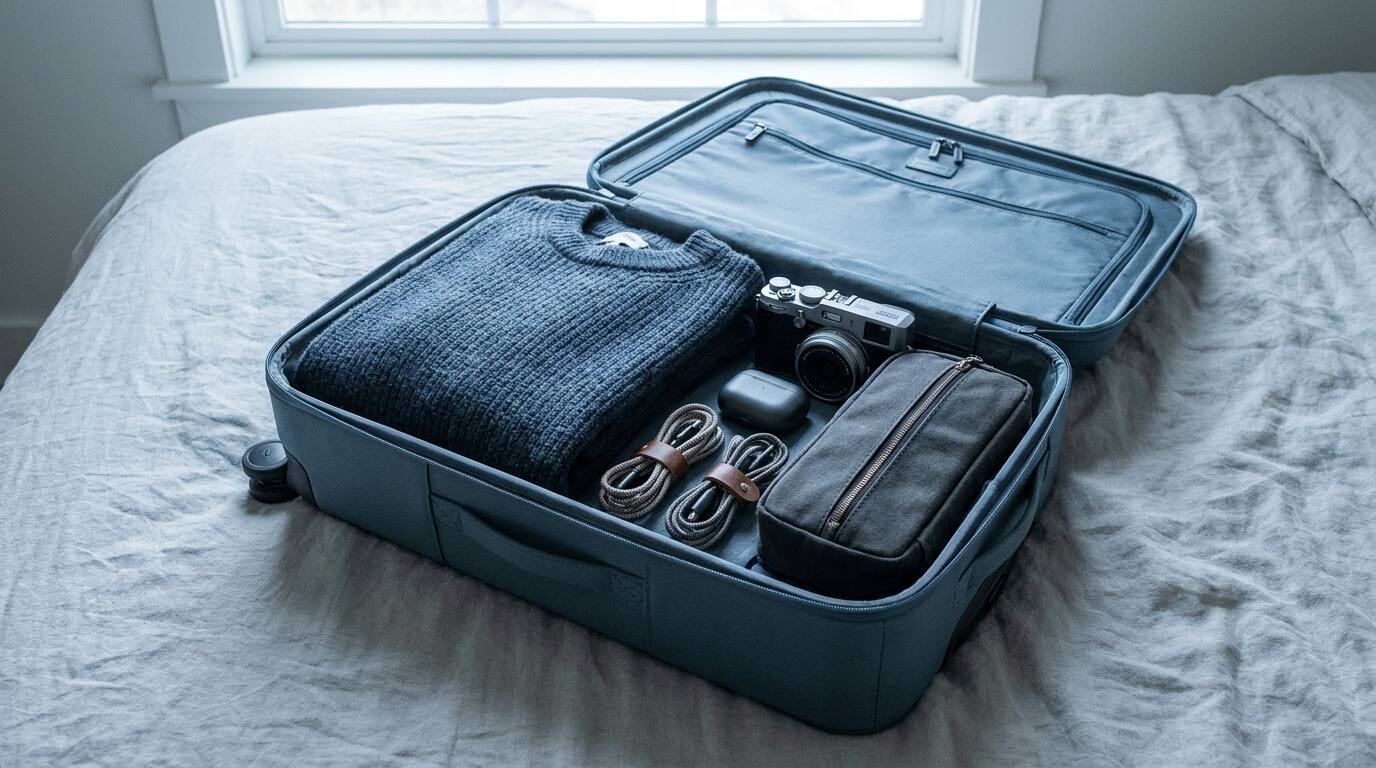
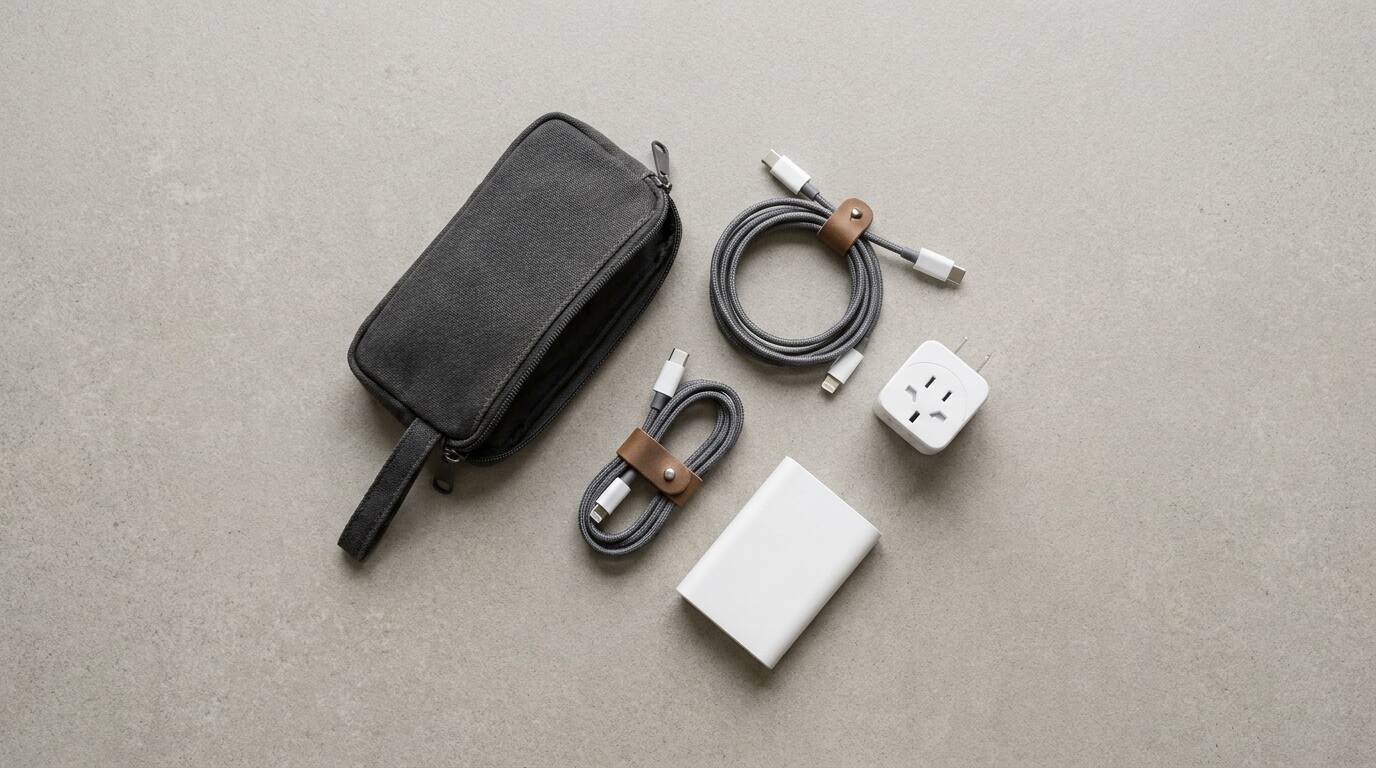
Not a gadget, but the habit that saves the most trouble. Charger, cables, adapter and power bank live together in one pouch that goes in the cabin bag. It means the battery-bearing items are already where the rules want them, and that the charger left plugged in beside a hotel bed is the first thing you notice missing at checkout. It also makes a security-line check quicker if a bag is opened, since everything electrical is in one place.
Bucket two: often not worth it
High-capacity batteries. Published passenger limits in the guidance below stop at 160 Wh, so anything bigger, such as the units in Portable Power Stations Explained for Beginners, should not be assumed to fly.
Single-voltage heating appliances. Hair dryers, kettles and straighteners built for one supply are the classic casualties abroad. Hotels often provide a dryer, and dual-voltage travel models exist.
A universal adapter with plugs for countries you are not visiting. Bulk and moving parts for no benefit. Take the shape you need, or two.
Loose spare batteries without protection. Bare terminals are a short-circuit risk, and the rules require them to be protected.
Duplicate single-purpose gadgets. If your phone does the job acceptably, a second device mostly adds another thing to charge.
This list is a judgement, not a rule. A photographer may reasonably carry a chunky charger; a long-haul cyclist may want a bigger power bank. The point is that each item should be there on purpose.
Battery rules that decide what goes in the cabin
Transport Canada's 2025 safety alert says spare lithium batteries, including power banks, must be carried in carry-on baggage only, that terminals must be protected from short circuit, and that if a carry-on is checked at the gate, spare batteries must be taken out and kept with you in the cabin. The UK Civil Aviation Authority says to always take power banks into the cabin and never charge one on any flight. For batteries rated above 100 Wh and up to 160 Wh, CATSA says spares need air carrier approval and are limited to two per person in carry-on. Airlines may set tighter limits of their own, including on how many power banks you may carry, so read your carrier's page before you pack.
Capacity is printed on many power banks in mAh, but the rules use watt-hours. Watt-hours equal volts multiplied by amp-hours. Battery University gives lithium-ion cells a nominal 3.6 to 3.7 V, so a 20,000 mAh bank works out at about 74 Wh (20 Ah × 3.7 V), under 100 Wh, while a 30,000 mAh bank is about 111 Wh (30 Ah × 3.7 V), in the band needing approval. These are illustrative arithmetic; always use the Wh figure printed on the product where there is one.
Five questions for any other gadget
Will I certainly use it on this trip, or only possibly?
Does its input label cover the destination's voltage and frequency?
If it has a battery, can it go in the cabin within airline limits?
Does something I already carry do the same job well enough?
Does it add another thing to charge, and do I have a spare port?
A "no" on the second or third question usually ends the discussion. A "no" on the fourth is the quiet reason most drawers of gadgets exist. Anything that comes through all five is probably earning its place, and the answers can change with the trip: a week of city hotels asks different questions from a fortnight of camping, where a larger battery may be sensible if you drive there rather than fly; and if you want to keep track of the bag itself, Bluetooth Trackers: What They Can and Cannot Do explains what trackers can and cannot do.
Before you zip the bag
Power bank in carry-on, Wh figure checked, not charging during flights.
Spare batteries individually protected against short circuits.
Labels checked on every device for destination voltage and frequency.
Adapter with the right plug shape and a safety mark, rated for what is plugged into it.
Cables and charger in one pouch so nothing is left behind in a hotel room.
How we research. Based on manufacturer documentation and the sources listed below. Know Your Gadget did not test products for this article. See our editorial policy.
The biggest number on a power bank, its mAh rating, is the hardest to compare. Watt-hours, conversion losses and USB power negotiation explain what you really get, and what airlines look at.
A Bluetooth tracker has no GPS and no mobile connection of its own. Here is how finding networks locate a lost item, where they fall short, and how unknown-tracker alerts work.