Outdoor & Travel
Compact Travel Gadgets: What's Worth Packing and What to Leave Behind
A short list of gadgets that earn their space in a carry-on, a second list of ones that often do not, and five questions for deciding about anything else.

An adapter changes the shape of a plug. A converter changes the voltage. Mixing them up is the most common way to damage a hair dryer on holiday.
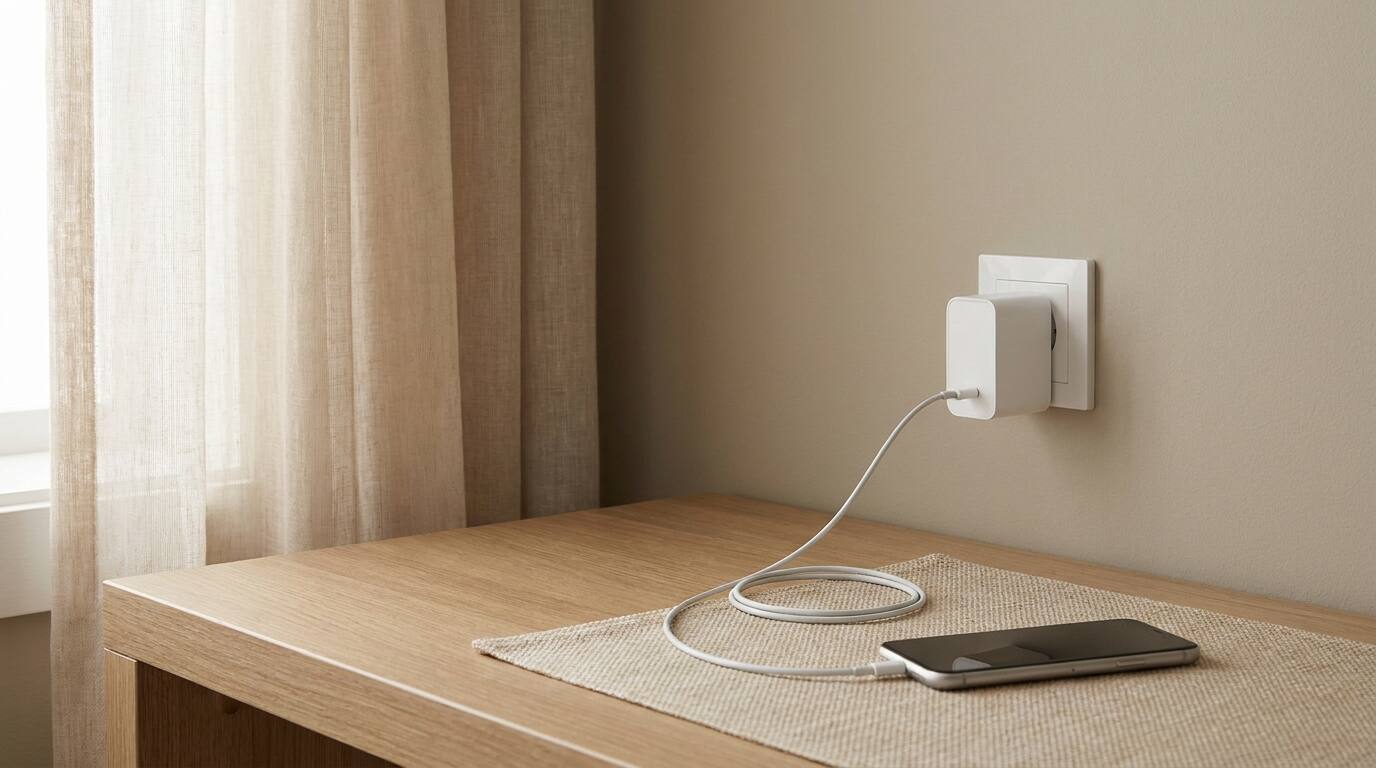
Picture a hair dryer built for a 230 V socket pushed into a hotel outlet in Toronto, or a Canadian 120 V kettle pushed into a socket in Sydney. The plug can be made to fit in either case. Whether the appliance survives is a separate question, and the plug adapter has no say in it. That gap between fitting and working is where most travel-electricity mistakes live.
An adapter is a passive piece of plastic and metal that connects one pin layout to another. Electrical Safety First, the UK charity, notes that an adapter does not convert voltage or frequency. Energy Safe Victoria says the same, and adds that adapters are designed for temporary use. A converter or transformer is an electrical device that changes the voltage. Different jobs, different failure modes.
| Canada | Australia | United Kingdom | |
|---|---|---|---|
| Nominal voltage | 120 V | 230 V | 230 V |
| Frequency | 60 Hz | 50 Hz | 50 Hz |
| Plug types | A (two flat parallel pins) and B (two flat parallel pins plus a round grounding pin) | I (two flat pins in a V-shape plus a flat grounding pin) | G (three rectangular blades in a triangular pattern, with an incorporated fuse) |
Notice what the table does and does not say: Australia and the UK share voltage and frequency, so travellers between them need to solve only the plug shape. Canada differs on both voltage and frequency. A device that travels between Canada and either of the other two has to cope with a different supply, not only a different socket.
It makes the plug fit. The device still receives whatever the local wall delivers. Energy Safe Victoria's guidance is blunt: check that the rating label matches the local mains voltage and frequency, which it gives as 230 V and 50 Hz in Australia, and if the label does not cover 230 V, or does not cover 50 Hz, do not use the appliance. A device marked for 120 V only, plugged into a 230 V supply through an adapter, receives roughly double the voltage it was designed for.
Not if the device is dual voltage. Look at the small print on the appliance or on its power supply. Electrical Safety First says dual-voltage appliances carry an input range such as 110-240 V. If the range spans both your home voltage and your destination's, an adapter alone is enough. Phone chargers and many laptop power supplies are labelled this way; hair dryers, kettles and curling tongs often are not, though some travel models are.
| Label says | Meaning | What you need |
|---|---|---|
| Input 100-240 V, 50/60 Hz | Handles all three countries in the table above | Plug adapter only |
| Input 220-240 V, 50 Hz | Covers the Australian and UK supply (230 V, 50 Hz) but not Canada's 120 V and 60 Hz | Adapter only in Australia or the UK; in Canada, check the maker's guidance first, because a converter may not suit the appliance |
| Input 120 V, 60 Hz | Built for the Canadian supply | Not suitable for Australia or the UK without a converter, and a heating appliance may not suit one |
A converter has a maximum power rating, and the appliance's wattage must sit comfortably inside it. Heating appliances use the most power, so they are the likeliest to exceed a small unit's limit. Electrical Safety First also warns that some electronic devices, such as game consoles, televisions, radios and computers, are not suitable for use with converters. The manufacturer's manual is the authority; if it does not mention foreign supplies, assume the answer is unknown.
Quality varies. Electrical Safety First says all travel adapters sold in the UK must meet the standard BS 8546, that not all adapters are designed for use in more than one country, and that some are unsuitable for appliances requiring an earth connection, which limits them to double-insulated equipment. It also advises buying adapters and converters before you leave, because products sold abroad may not meet UK safety standards. In Australia, Energy Safe Victoria's fact sheet says to look for the RCM mark and for plug pins with plastic insulation.
Match the adapter's stated maximum rating, shown in amps or watts, to what you will plug into it. A multi-way adapter that powers a phone, a laptop and a camera battery charger is a different load from one carrying a dryer.
They share nominal voltage and frequency, which is helpful, but the plugs are different: type I in Australia and type G in the UK, and the UK type has a fuse inside the plug. The practical rule still holds: confirm the label covers 230 V and 50 Hz, then fit the right adapter. For gear that you take on trips, Compact Travel Gadgets: What's Worth Packing and What to Leave Behind looks at what is worth carrying; for battery-powered kit, Portable Chargers: Understanding Capacity and Charging Speed explains why power banks are a separate question. The Outdoor & Travel section collects the rest.
Before you plug in abroad
How we research. Based on manufacturer documentation and the sources listed below. Know Your Gadget did not test products for this article. See our editorial policy.
Outdoor & Travel
A short list of gadgets that earn their space in a carry-on, a second list of ones that often do not, and five questions for deciding about anything else.
Everyday Tech
The biggest number on a power bank, its mAh rating, is the hardest to compare. Watt-hours, conversion losses and USB power negotiation explain what you really get, and what airlines look at.
Home Gadgets
A smart plug adds remote and scheduled switching to anything with an ordinary plug. It is a handy low-effort upgrade, as long as you match it to the right appliance and set it up with security in mind.