Kitchen & Lifestyle
Small Kitchen Appliances Worth Understanding Before You Buy
Seven questions that sort the appliances you will use weekly from the ones that end up in a cupboard, plus a matrix for comparing worktop footprint, power and cleaning.

Kettles, scales, grinders, brewers and milk tools, sorted by the kind of morning you actually have rather than by price tier or hype.
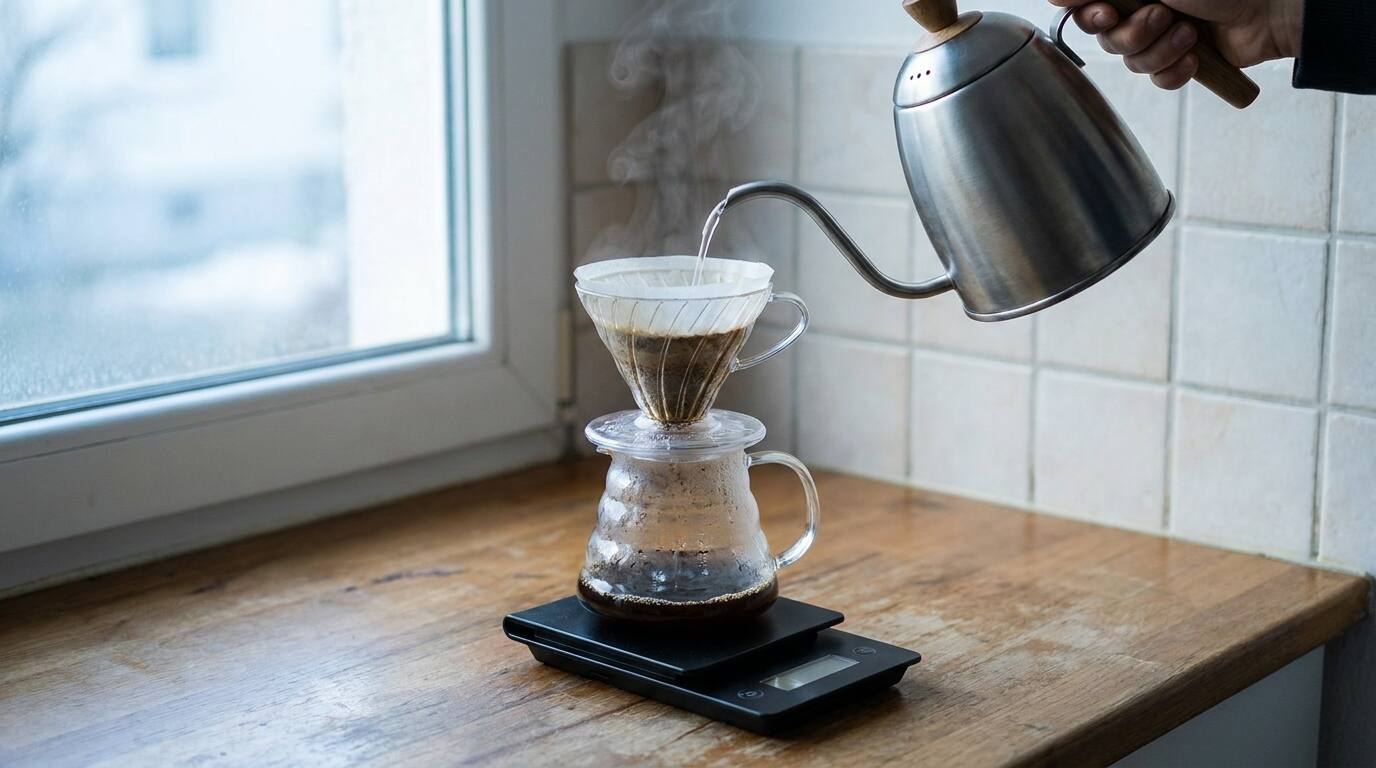
The kettle clicks off, the scale is zeroed, and nobody has said a word yet. For many households the first twenty minutes of the day are less about coffee than about not having to make decisions, and the gadgets that stay on the worktop are usually the ones that remove a decision rather than add a step.
That is the lens for this tour. Instead of ranking devices, it follows three kinds of morning and asks what each type of coffee gadget genuinely contributes, what it asks of you in return, and where the marketing runs ahead of the physics. No products are named or recommended here; the aim is to help you recognise what you are looking at when you browse.
On a rushed morning, consistency beats craft. The most useful change is often the least glamorous: a kitchen scale. Coffee measured by the scoop varies with the roast and the grind, while coffee measured in grams does not. The coffeeresearch.org brewing guide suggests 55 grams of ground coffee per litre of filtered water for a standard filter brew, and a University of California, Davis brewing study discussed in a Specialty Coffee Association lecture used that same 55 g to 1,000 g ratio for every batch. Treat it as a starting point, then adjust to taste by a few grams.
Next comes the kettle. Temperature-control kettles let you stop short of the boil, which matters less than it sounds. In the SCA-backed Davis research, brew temperatures from 87°C to 93°C produced little difference in flavour once strength and extraction were held constant, and temperature was not a meaningful predictor of how much consumers liked a cup. A pre-set to roughly 90–96°C is a sensible target for most methods (that is the 195–205°F range the same brewing guide quotes), but a variable dial is a convenience, not a quality guarantee. What it does buy you is repeatability and, on some models, a hold function.
For the brewer itself, the weekday contenders are an automatic drip machine, a capsule or pod system, or a bean-to-cup machine that grinds, doses and brews on a button. The trade-offs are plain. Drip machines are cheap to understand and handle multiple cups, but they vary in how quickly the water reaches the right temperature; the SCA notes that home brewers which cannot reach 92°C quickly enough fail its certification, which tells you the heater matters more than the badge. Capsule systems trade running flexibility and waste for speed. Bean-to-cup machines remove the most steps but add the most cleaning, so read their routine before you read their feature list.
Saturday is where manual brewing earns its place. A pour-over cone, an immersion brewer such as a French press, or a stovetop moka pot each shape the cup differently, and each rewards a different habit. Pour-over is the most hands-on and the most sensitive to how you pour and how fine you grind; immersion is forgiving and nearly impossible to ruin badly; a moka pot makes a small, strong, espresso-like coffee, though base size and material decide whether it works on your hob, so check the manual if you cook on induction.
A gooseneck kettle, with its narrow spout, only matters for pour-over, where flow control is the whole technique. If you brew with a press or a drip machine, you can ignore it.
Grinders are where weekend money tends to go, and the logic is sound: grinding just before brewing keeps the coffee fresher, and a burr grinder is designed to produce a more even particle size than a blade chopper, which shears beans at random. Hand grinders suit one or two cups and a quiet kitchen; electric burr grinders suit larger volumes and early starts. The honest limitation is that a better grinder cannot rescue stale beans or poor water, and an adjustable dial is only useful if you actually record which setting worked.
| Your morning | Gadget type worth a look | What it asks of you |
|---|---|---|
| Rushed, one cup | Scale, drip machine or capsule system | Weighing beans; or accepting capsule waste and running costs |
| Rushed, several cups | Automatic drip machine with insulated carafe | Regular descaling, rinsing the basket |
| Slow, solo | Pour-over cone, hand grinder | Patience, a steady pour, a spare five minutes |
| Slow, shared | Immersion press, electric burr grinder | Noise at breakfast, more washing-up |
| Milk-based drinks | Jug frother or machine with steam wand | Immediate cleaning after every use |
| Prepared the night before | Cold brew jug | Fridge space and a planning habit |
Water and limescale decide how long a machine stays pleasant to use. Manufacturers tie descaling to local water hardness; De’Longhi’s support guidance, for example, suggests descaling a pump espresso machine after about 200 uses, adjusted to hardness, and notes that some models can be set to your water so the indicator comes on at the right time. Your own manual overrides any general rule, including which descaler to use. If you live where the water is hard, a machine with a clear, simple descaling routine is worth more than an extra function.
Water quality affects flavour as well. The coffeeresearch.org guide advises filtered water and warns against distilled water, which lacks the minerals that bring out flavour. Beyond that, the local rules and what is in your tap vary a great deal across Canada, Australia and the UK, so check with your water supplier if you want specifics.
Then there is standby draw. Natural Resources Canada notes that standby power can account for 5 to 10 per cent of a household’s electricity bill overall, and specifically suggests plugging a coffee maker into a power bar and switching it off when not in use. Many machines have their own auto-off timers; a gadget that keeps its water hot all day is worth checking against that.
One further point for households that like automation: a smart plug can start a simple kettle or machine on a schedule, but heating appliances draw a lot of current and not every plug is rated for them. That question is covered in Smart Plugs Explained: Useful Ways to Upgrade Your Home.
How we research. Based on manufacturer documentation and the sources listed below. Know Your Gadget did not test products for this article. See our editorial policy.
Kitchen & Lifestyle
Seven questions that sort the appliances you will use weekly from the ones that end up in a cupboard, plus a matrix for comparing worktop footprint, power and cleaning.
Home Gadgets
A smart plug adds remote and scheduled switching to anything with an ordinary plug. It is a handy low-effort upgrade, as long as you match it to the right appliance and set it up with security in mind.
Outdoor & Travel
A short list of gadgets that earn their space in a carry-on, a second list of ones that often do not, and five questions for deciding about anything else.